
The Full Contractor Safety Management Lifecycle
EBOOK | 15 MINUTE READ The Full Contractor Safety Management Lifecycle Contractors introduce a complicated risk profile, operating outside standard workflows, move between sites and bring varying levels of training, oversight and risk exposure. As a result, even organizations with strong internal safety processes can struggle to maintain consistent standards when contractors are involved. This guide outlines a practical framework for managing contractor […]
Building a Contractor Safety Management Program: Challenges and Best Practices

Building a Contractor Safety Management Program: Challenges and Best Practices Summary: Contractor safety management ensures that temporary workers operate under the same safety expectations as your direct workforce. It requires clear qualification standards, consistent onboarding, active oversight and continuous performance monitoring to reduce risk across job sites. Done well, it helps organizations meet global compliance requirements and maintain consistent EHS&S performance even as contractor […]
Transitioning to a Digital Health and Safety Platform: What You Need To Know

The Problem With PQQ-Based Contractor Management (And How To Solve It) Summary: Pre-qualification questionnaires (PQQs) remain a core part of contractor management, assess and approve contractors before work begins. However, while PQQs may help screen contractors at the point of entry, they are poorly suited to serve as a comprehensive, on-going risk management system. What Is PQQ-Based Contractor Management? Prequalification questionnaires help establish minimum expectations around competency, insurance, training and incident history to qualify if […]
Early Signs of SIF Risk: How To Identify Serious Injury and Fatality Precursors

Early Signs of SIF Risk: How To Identify Serious Injury and Fatality Precursors Very rarely does a serious workplace incident occur without warning. In most cases, early warning signs are present well before a serious injury or fatality (SIF) takes place. These warning signs provide an opportunity to intervene before risk escalates into life-altering harm. Organizations that focus on identifying and addressing early signs […]
Evotix Live Series: Resolve Incidents Faster. Reduce Risk Over Time.
Beyond PQQs: Building a Risk-Based Contractor Management Lifecycle
Serious Injury and Fatality (SIFs) Prevention: A Guidebook for EHS Professionals
Table of Contents Evotix Guide Serious Injury and Fatality (SIF) Prevention: A Guidebook for EHS Leaders While total recordable incident rate have steadily declined in recent years, serious injury and fatality rates have plateaued. This shows that traditional safety frameworks are not enough to combat serious harm. Organizations need a way to understand where serious injuries and fatalities could […]
Modernizing Safety: Data, People and Technology in Today’s EHS Landscape
Serious Injury and Fatality Prevention: Definitions, Barriers and What EHS Leaders Say Actually Works

Serious Injury and Fatality Prevention: Definitions, Barriers and What EHS Leaders Say Actually Works Every EHS leader can broadly agree that the most important part of the work is keeping people safe. Serious injuries and fatalities should not be accepted as the standard cost of doing business. Harm is preventable and SIF prevention matters. Research […]
Risk Recalibrated: the 2026 Executive Leadership Report on AI, SIF and Human-Centric EHS
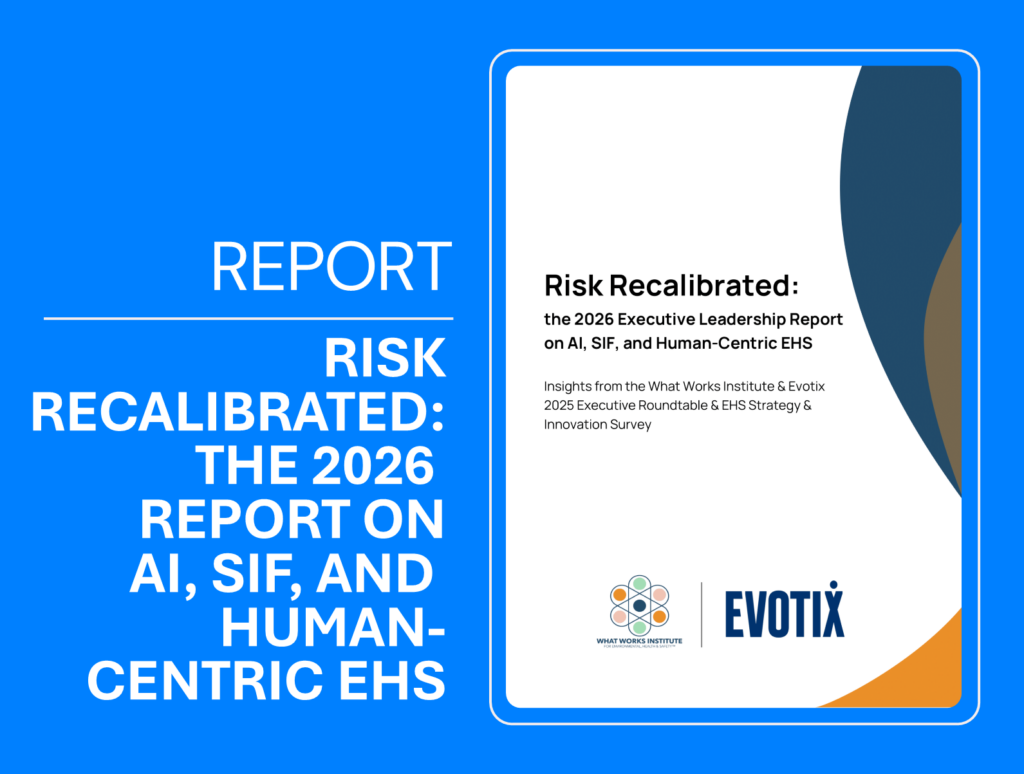
EHS Research & Trends Research and insights from senior EHS professionals across manufacturing, utilities, construction and beyond. Download full report Read the summary senior EHS leaders surveyed 0 industries represented 0 + oversee multi-site or global ops 0 % executive leadership report 0 View full methodology → How EHS defines and manages serious risk is […]