

Most organizations treat EHS and ESG as separate programs. Safety teams manage incidents, audits and compliance in one system. Sustainability teams track emissions, waste and disclosure requirements in another. In these organizations, the two rarely talk to each other until reporting season forces the conversation.
There are multiple costs to your bottom line if you elect to manage these programs separately. When ESG data isn’t grounded in operational reality, disclosures become difficult to defend. When sustainability goals aren’t connected to the teams and systems where work actually happens, progress doesn’t happen. When EHS and ESG run on different platforms, the effort required to reconcile them pulls resources away from the work that matters.
Leading enterprises take a different approach to managing these workflows, bringing EHS and ESG into a shared operational system. Before we identify the vendors who do this best, here’s what you should know about why unified EHS and ESG platforms matter and how to choose the best option for your business.
The push to integrate EHS and ESG is about improving credibility and efficiency.
According to Verdantix, the convergence of EHS, ESG and supply chain sustainability is driving demand for integrated software solutions that can address these interconnected challenges. The firm has also noted that fragmented tools and manual workflows are exposing the limits of reactive safety and sustainability programs. Organizations that run EHS and ESG in separate systems can already feel that friction.
When sustainability goals live in a separate system from safety workflows, accountability breaks down. Teams can’t connect ESG targets to the actions, owners and timelines that would actually move the needle. Environmental data gets collected in parallel rather than captured at the source. As disclosure season arrives, assembling a defensible report requires reconciling data that wasn’t initially designed to work together.
A unified EHS and ESG platform changes what’s possible across four main areas:
Not every platform that claims to cover both EHS and ESG does so with equal depth. Some treat sustainability as a reporting module bolted onto a safety system. Others build ESG into the platform architecture from the start. The difference matters when you’re making a long-term investment. Here are five criteria worth evaluating carefully.
EHS and ESG data should live in the same system and inform each other. Incident data should be available when assessing material ESG topics. Environmental data should flow into compliance workflows without manual intervention. If the platform requires data exports and imports to connect safety and sustainability information, the integration is superficial. Look for a single source of truth across all modules.
Reporting requirements are expanding and vary by region, industry and stakeholders. A capable platform should support the frameworks your organization is working toward like GRI, CSRD, ISO 14001 or ISO 45001. They should also keep pace with regulatory changes without requiring custom development on your end. Ask vendors specifically how they handle framework updates.
ESG performance is built through daily operational decisions and should not wait until year end to be assembled. Look for a platform where important sustainability workflows like waste management, emissions capture, permit management and chemical oversight are built into the same environment where safety and compliance workflows happen. If ESG only shows up at the reporting layer, the underlying data will always require reconciliation.
Your organization’s processes, terminology and compliance obligations are specific to you. A platform that requires significant IT involvement every time you need to adjust a form, update a workflow or add a new site creates friction that slows adoption. No-code configuration and role-based permissions give EHS and sustainability teams the control they need to keep the system aligned with how work actually gets done.
AI capabilities in EHS and ESG software are advancing quickly, but not all implementations are equally useful. The most valuable applications surface relevant guidance inside active workflows (during an incident investigation, an audit or an emissions calculation) rather than generating summaries after the fact. For ESG specifically, AI outputs need to be traceable and explainable. Investors and regulators aren’t interested in outputs your team can’t defend.
This list reflects widely evaluated ESG and EHS platforms based on market presence, capabilities and commonly referenced customer feedback.
Evotix is the top choice for organizations that want EHS and ESG managed in a single operational system rather than connected after the fact. Recognized as a Leader in the Verdantix Green Quadrant for EHS Software, the platform brings safety, compliance, risk, occupational health and sustainability into one shared data model. ESG performance is built into daily work through modules for emissions management, waste tracking, environmental permits, metrics and materiality, and framework reporting — all running in the same environment as incident management, audits and inspections.
EvoAI, Evotix’s embedded AI capability, surfaces guidance directly inside ESG and EHS workflows so teams can act on risks and sustainability data in the moment rather than reviewing summaries after the fact. The platform is designed for organizations that need their ESG disclosures to be traceable and defensible.
Key features:
Best for:
Evotix is best for mid-market and enterprise organizations that want EHS and ESG in one system with strong frontline adoption, AI-powered insights and the configurability to scale across multiple sites and regions.
Praise from customers :
“Evotix has helped us achieve our sustainability goals.”
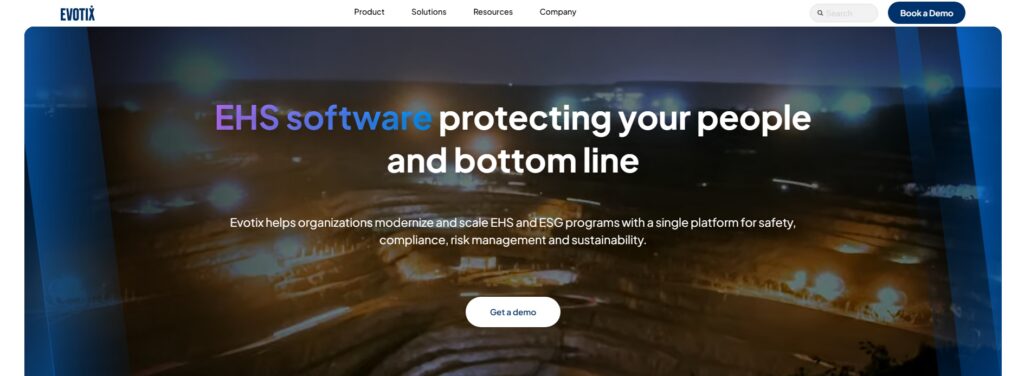
Sphera positions itself as an enterprise sustainability management platform, combining EHS, operational risk, process safety and ESG in a single system with particular depth in environmental data management. The platform is a strong fit for asset-intensive industries where operational risk and sustainability reporting need to connect across multiple jurisdictions. Verdantix recognized Sphera as a market leader in both the Green Quadrant for EHS Software and the Green Quadrant for ESG and Sustainability Software, noting differentiated capabilities in GHG emissions, hazardous waste and sustainability planning.
Key features:
Best for:
Large enterprises in oil and gas, chemicals, refining and heavy industry where process safety, environmental accounting and ESG governance need to work together.
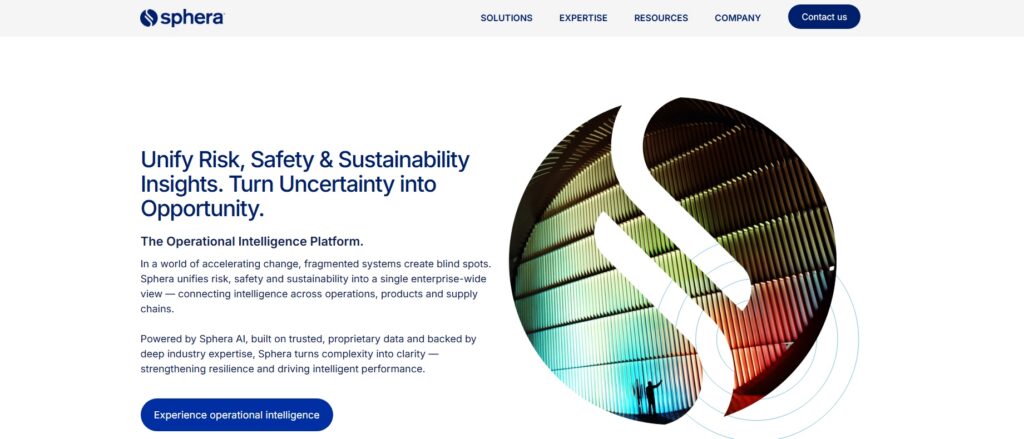
Enablon is a well-established integrated risk management platform that covers EHS, sustainability, operational risk and governance within a single system. Part of Wolters Kluwer, the platform is built for multinational organizations where EHS is one component of a broader compliance and governance strategy. Verdantix recognized Wolters Kluwer as a leader in ESG reporting software, noting strong framework coverage and compliance configurability across more than 160 countries.
Key features:
Best for:
Global enterprises with complex governance requirements, multi-jurisdiction regulatory obligations and organizations where EHS and ESG need to connect to broader GRC programs.
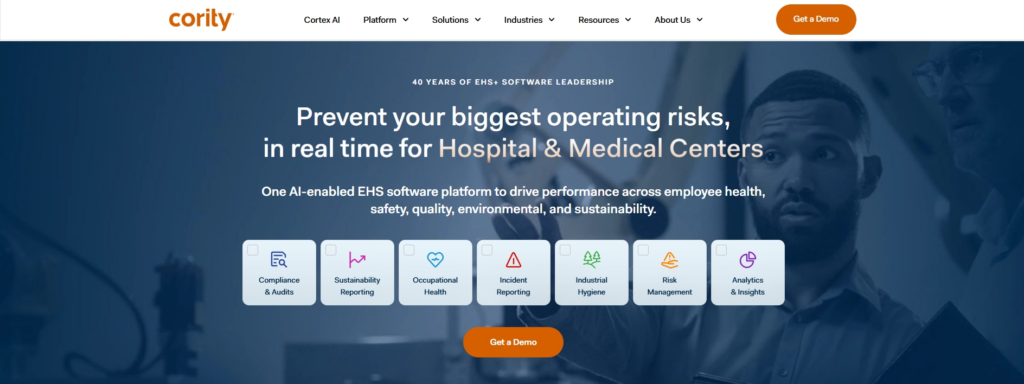
Cority offers a broad EHSQ platform with recognized strength in occupational health alongside its safety and sustainability capabilities. The platform takes a unified approach across safety, industrial hygiene, environmental management and ESG reporting, and has been recognized by Verdantix in its Green Quadrant for ESG and Sustainability Software for expanding functional depth through strategic acquisitions. Organizations with complex occupational health programs that also need ESG reporting in the same system will find Cority worth evaluating closely.
Key features:
Best for:
Organizations in heavy industry and healthcare that need occupational health, EHS and ESG managed in a single system.
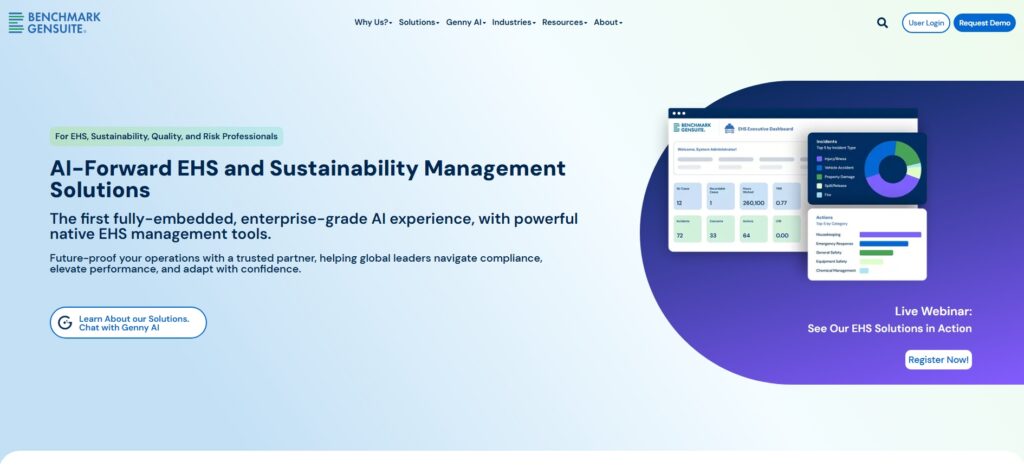
Benchmark Gensuite serves multi-site enterprises with a broad platform covering EHS, sustainability and ESG reporting. The modular architecture allows organizations to implement what they need and scale over time, from basic compliance management to advanced ESG data capabilities. The platform’s Genny AI assistant supports regulatory tracking and cross-functional reporting, and Verdantix recognized Benchmark Gensuite in its Green Quadrant for ESG and Sustainability Software for combining sustainability tools with strong AI applications.
Key features:
Best for:
Multi-site enterprises in regulated industries that want a scalable platform with strong ESG data management and AI-assisted compliance tracking.
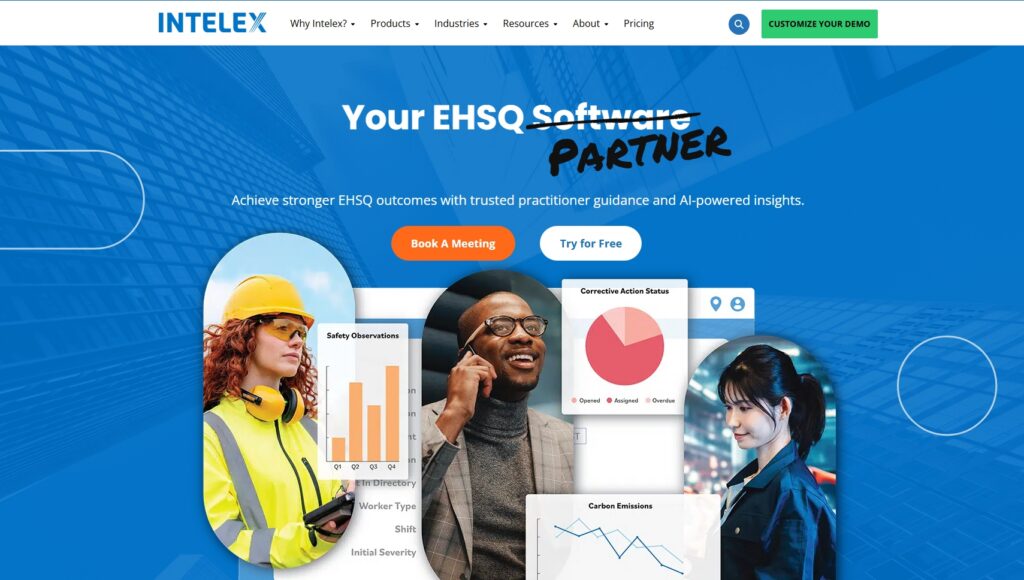
Intelex is a highly configurable EHSQ platform, now part of Fortive, with broad coverage across safety, quality, environmental management and ESG. The platform is often evaluated by organizations looking to unify EHS and quality alongside sustainability in a single system. Its application builder allows administrators to configure workflows to specific site requirements, and automated workflows help teams stay on top of corrective actions and compliance obligations across large, distributed operations.
Key features:
Best for:
Organizations that need EHS, quality and ESG unified in one system with high configurability across a large number of sites.
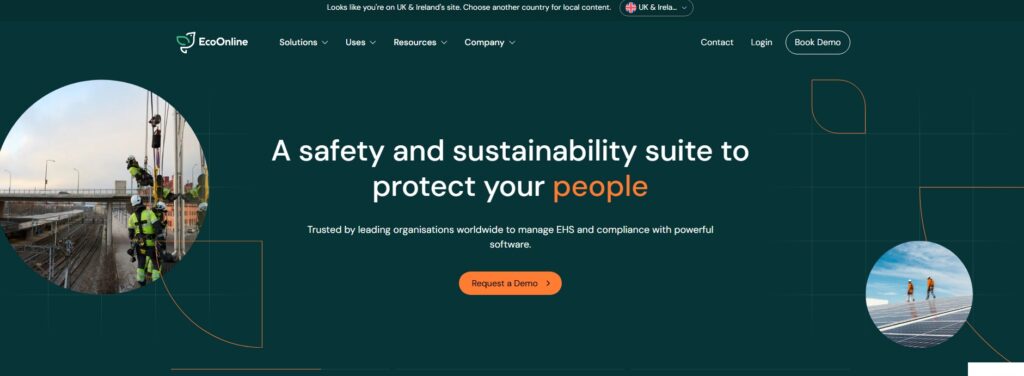
EcoOnline is a European-founded EHSQ platform that has grown through acquisition to cover safety, chemical management, environmental compliance and ESG reporting. The platform’s origins in chemical safety give it particular depth in SDS management, COSHH workflows and hazardous substance tracking — capabilities that connect directly to environmental and ESG performance for organizations managing high-hazard materials. EcoOnline has expanded its sustainability coverage through its acquisition of Ecometrica, adding carbon accounting to its suite.
Key features:
Best for:
Organizations in high-risk, chemical-intensive industries that need strong hazardous substance management alongside EHS and ESG capabilities in one system.
Withmany platforms covering both EHS and ESG, the right choice comes down to your organization’s specific operations, risk profile and reporting obligations. The table below is a starting point for narrowing the field.
| If your organization… | Look for software with… |
| Manages EHS and ESG in separate systems today | Unified modules, a single source of truth and ESG workflows built into daily operations |
| Faces complex regulatory or disclosure requirements | Broad framework coverage including CSRD, GRI, TCFD and ISO standards, with audit-ready data structures |
| Needs strong frontline adoption across distributed teams | Mobile-first access, offline capability, intuitive forms and no-code configuration |
| Has significant occupational health or industrial hygiene needs | A platform with clinical hygiene workflows integrated alongside safety and ESG |
| Operates in asset-intensive or chemical-heavy industries | Deep environmental data management, process safety and hazardous substance capabilities |
| Is early in ESG maturity and building toward disclosure | Guided forms, engaging microlearning and streamlined feedback loops |
Is early in digital transformation and needs fast time-to-value | Preconfigured best-practice workflows, materiality management tools and guided implementation support |
| Needs ESG data to meet investor or financial-grade scrutiny | Traceable calculations, audit-ready evidence libraries and AI that can explain its outputs |
If you are earlier in your evaluation and want to understand the full landscape of what unified EHS and ESG software can do for your organization and how to find the right solution for your business, the additional resources below are a useful starting point:
Choosing a platform that unifies EHS and ESG takes more than comparing feature lists. The right solution should make sustainability part of how your organization operates every day, not something that gets assembled under pressure at reporting time. If you want to see how Evotix brings both together in a single system, book a demo to explore it firsthand.

Share