


Most executive safety reviews begin the same way: a rate appears on screen that either trends up or down. The team makes comparisons against last quarter, last year or industry averages. The entire conversation hinges on whether that number improved.
That number is TRIR, or total recordable incident rate.
For decades, TRIR has been the shorthand for safety success. It’s widely used, understood and embedded in reporting systems across industries. The problem? Safety performance is far too complex to reduce to a single rate.
As serious injuries and fatalities continue to rise across many industries, EHS leaders are asking themselves a rather uncomfortable question: Are we measuring the factors that actually prevent life-altering harm?
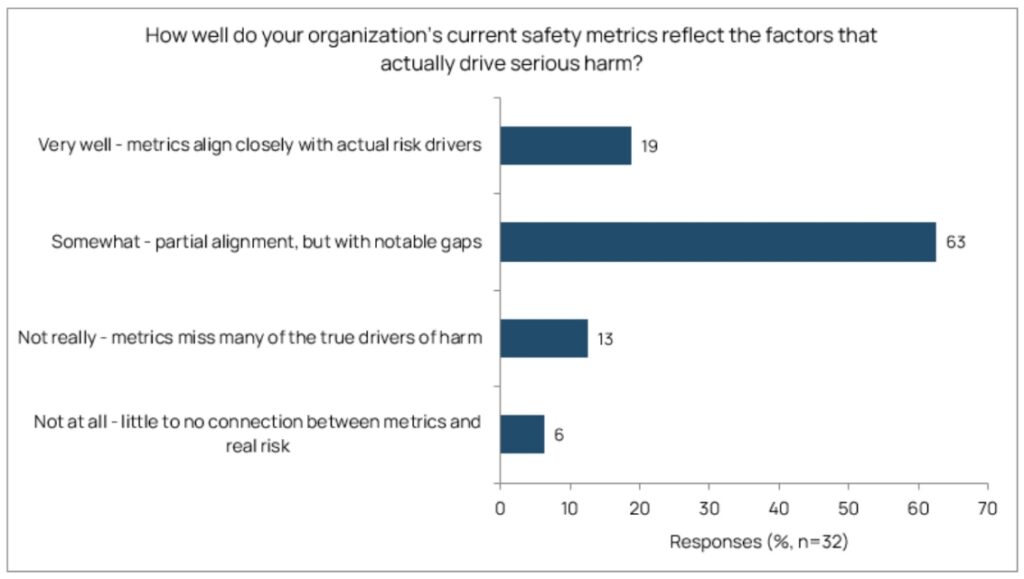
Research from Evotix and What Works Institute suggests there’s some serious work to do. Only 19% of EHS leaders believe their current safety metrics closely track the factors that drive serious harm. Another 63% say those metrics only partially reflect real risk drivers. Nearly 20% report little or no connection at all. The disconnect is real, and leaders can feel it.
Total recordable incident rate (TRIR) measures the number of OSHA-recordable injuries and illnesses per 200,000 hours worked, roughly equivalent to 100 full-time employees working for a year.
The formula standardizes injury rates so a 50-person manufacturer can compare itself to a 5,000-person operation. Regulators adopted it, industry groups benchmarked against it and boards have tracked it for decades.
TRIR is simple and consistent. It allows trend analysis over time. To its credit, the metric has helped reduce minor injuries across many industries. But where TRIR breaks down is when we consider catastrophic risk.
TRIR is backward-looking. It tells you what already happened but offers no insight into future risk. Furthermore, it ignores near-misses entirely and can inadvertently reward underreporting.
Consider the math: a single fatality in a large organization may barely move the rate. A year without fatalities doesn’t necessarily mean exposure to fatal potential has decreased. It might just mean you got lucky.
TRIR also treats all recordable injuries the same. A minor laceration and a spinal cord injury both enter the numerator with equal weight. There’s no distinction for severity and no accounting for life-altering consequences.
The research calls out this disconnect directly. Despite broad recognition of TRIR’s shortcomings, the metric persists. Inertia and external pressure from regulators, industry bodies, investors and legacy incentive schemes keep it in place.
One roundtable participant described the dynamic as “performance theater.” Often, you’ll find that organizations optimize for the optics of safety rather than the integrity of serious-risk control.
If you’re looking to modernize your safety reporting approach, center it on three principles: exposure, readiness and learning. This will help you more directly reflect serious risk control and organizational reliability. Here’s what to measure and monitor in addition to TRIR:
Instead of asking whether someone got hurt, ask how often workers encounter high-energy or high-hazard tasks. More importantly, verify whether critical controls are reliably in place and actually functioning.
Consider measuring factors like:
Take a manufacturing plant with 200 employees. Under the old model, leadership celebrates a year with zero recordable injuries. Under the new model, they ask: How many times did workers enter confined spaces this year? Were atmospheric tests conducted every time? Did lockout procedures hold under audit?
The question shifts from “How many people were hurt?” to “How often are we exposed to catastrophic potential, and are our controls holding under real conditions?” That reframing aligns more closely with preventing serious injury and fatalities.
More than half of organizations now flag potential serious injury events to leadership. Nearly as many track leading indicators through dashboards and exposure analytics.
High-potential near misses, unsafe conditions and corrective action effectiveness all provide earlier warning signs of accumulating risk. The best safety programs treat rising near-miss reports as evidence of engagement rather than system failure, especially when people see their concerns addressed quickly.
The shift happens because transparency stops being a threat to performance metrics and instead becomes proof of strong workplace safety.
This is the piece that’s easy to talk around and hard to measure, which is exactly why it matters.
The report highlights indicators like trust, speak-up confidence and perceived management commitment. Interviews and pulse surveys can catch weak signals before they manifest as incidents.
The logic is straightforward and understandable. If your team members don’t believe reporting will lead to change, they won’t report things. If they expect blame, they’ll keep close calls to themselves. If supervisors are inconsistent, hazards get normalized.
Climate measures give leaders visibility into whether the system is working as intended, not just whether the numbers look clean on a dashboard.
As you track safety, don’t stop at whether the work was done. Instead, ask whether that work was done well.
The report points to indicators that measure system health: investigation timeliness and quality, audit completion as planned, and training effectiveness that goes beyond checking a “completed” box to measuring retention and on-the-job application.
This matters because weak learning systems produce weak improvement. The research backs this up. 59% of respondents flagged training and onboarding as most in need of redesign. Another 47% flagged investigations and learning systems. Leaders are clearly searching for stronger infrastructure behind the metrics.
Keep in mind that fatigue, stress and cognitive overload also contribute to serious injuries. Track overtime patterns, run targeted surveys and monitor other signals that reveal when your workforce is stretched too thin.
Many organizations are measuring these markers which reflects a broader shift toward human-centric safety. Physical hazards still matter, but so do workload, attention capacity and psychological strain. A fatigued worker operating heavy equipment faces compounding risk that traditional metrics miss entirely.
What you measure influences behavior, often in unintended ways. When bonuses, public reporting or executive scorecards tie solely to low injury rates, the implicit message becomes: avoid bad numbers at all costs.
As you integrate exposure tracking and precursor analytics, incentive systems need to evolve. That might mean recognizing:
Encouragingly, EHS leaders seem to be recalibrating.
When asked to rank priorities for the next 18 to 24 months, SIF exposure tracking emerged as the highest focus area. Simplifying and streamlining safety systems ranked second, reflecting frustration with operational clutter and a desire to align metrics with what truly drives outcomes.
Preventing serious injuries and fatalities requires clearer visibility into exposure, stronger control assurance and more disciplined learning systems. The old playbook simply isn’t cutting it.
We’re not suggesting you completely discard TRIR. Rather, consider TRIR contextualized alongside other risk factors. Your outcome metrics still matter, but they can’t stand alone as indicators of serious-risk control.
Safety metrics have long served as shorthand for performance, and they’ve driven real improvements in many areas. But as the field matures, the measures need to mature with it.
The opportunity now is realignment. Measure things like:
Modernizing safety metrics is complex work. It requires board-level conversations, cross-functional alignment and careful incentive redesign. But EHS leaders can’t wait for perfect conditions. The shift from measuring records to measuring risk needs to start right now.
Want to learn more?
Download the full 2026 Risk Recalibrated report for more insights.

Share