



Every EHS leader can broadly agree that the most important part of the work is keeping people safe. Serious injuries and fatalities should not be accepted as the standard cost of doing business. Harm is preventable and SIF prevention matters.
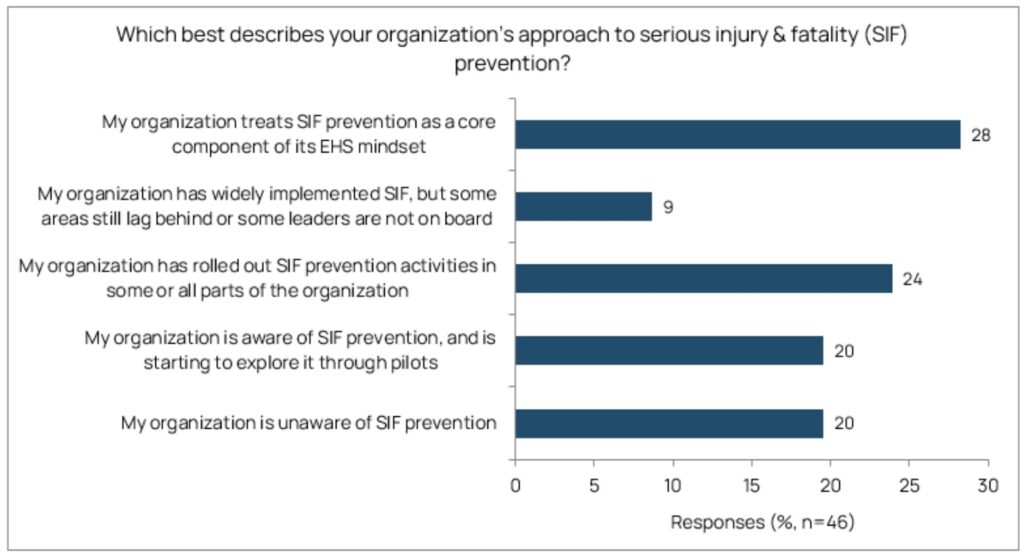
Research from Evotix and What Works Institute shows that 80% of organizations have at least started addressing serious injury and fatality prevention in some way. Some are running pilots. Some have updated investigation processes. Some are bringing SIF risk into leadership conversations more often. 28% consider SIF prevention a core component of their EHS mindset.
What leaders don’t agree on though, is what actually constitutes a SIF. When “SIF” means different things to different teams, SIF prevention is that much harder.
A serious injury and fatality (SIF) is an incident or near miss that results in or has the potential to produce a fatal or serious injury or illness. SIFs have devastating effects on individuals, families, coworkers, organizations and communities.
Definitions vary across companies, and sometimes even within them. Some organizations define SIF narrowly, focusing on immediate, high-severity physical trauma. Others expand the definition to include long-latency occupational illness, such as silicosis. Still others include acute psychological harm or trauma resulting from serious events. In some companies, all of these definitions coexist depending on who you ask.
This lack of consistency creates real friction. It muddies data and complicates benchmarking. Leaders can’t confidently say what they’re prioritizing or why.
In the executive roundtable conducted alongside the survey, leaders described the need for a flexible, modular approach to SIF definition: a core definition anchored in life-altering harm and aligned to emerging references (e.g., Edison Electric Institute, ASTM), surrounded by adjustable modules for industry-specific risks and contexts. Without that alignment, SIF efforts struggle to scale.
Want to learn more?
For more information on how to advance your organization’s SIF prevention strategy, visit our guide for EHS professionals.
Most organizations aren’t sitting still despite the definitional chaos.
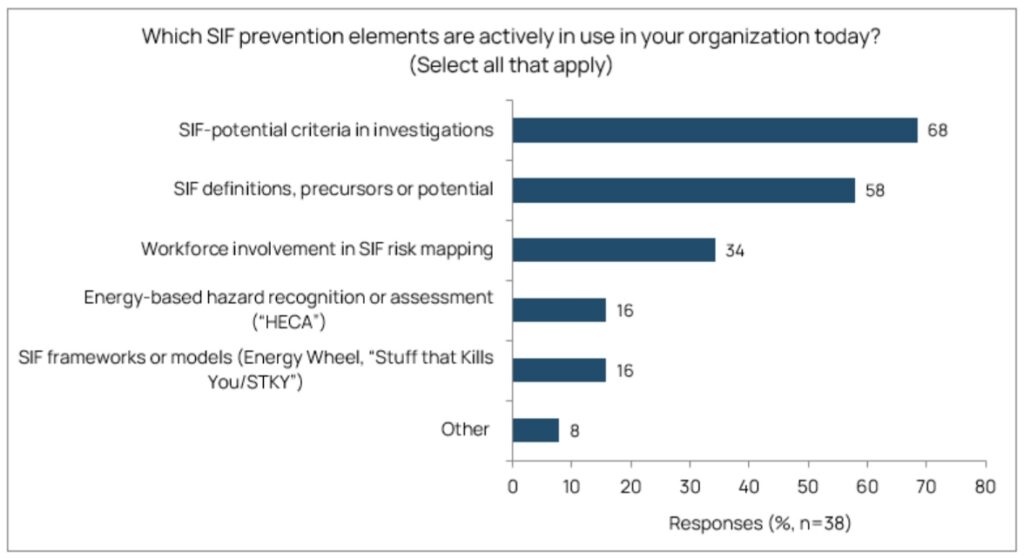
More than two-thirds of organizations now incorporate SIF-potential criteria in their investigations. They’re explicitly asking: “Could this have been fatal or life-changing?” That’s a meaningful shift from traditional incident response, which often focuses on what happened rather than what could have happened.
Nearly 60% have defined SIF precursors or high-risk situations to watch for. These are the warning signs – the near misses, close calls and moments when energy nearly transferred to a person but didn’t. Tracking precursors allows teams to intervene before the worst happens.
When it comes to more structured approaches though, adoption drops off. Only 16% report using energy-based hazard recognition or assessment HECA. And the same number report using SIF frameworks like Dr. William Haddon’s Energy Wheel or “Stuff That Kills You” (STKY) lists. Whether this reflects complexity, perceived genericness or simply early awareness isn’t clear. What is clear: there’s a gap between broad SIF thinking and systematic SIF management.
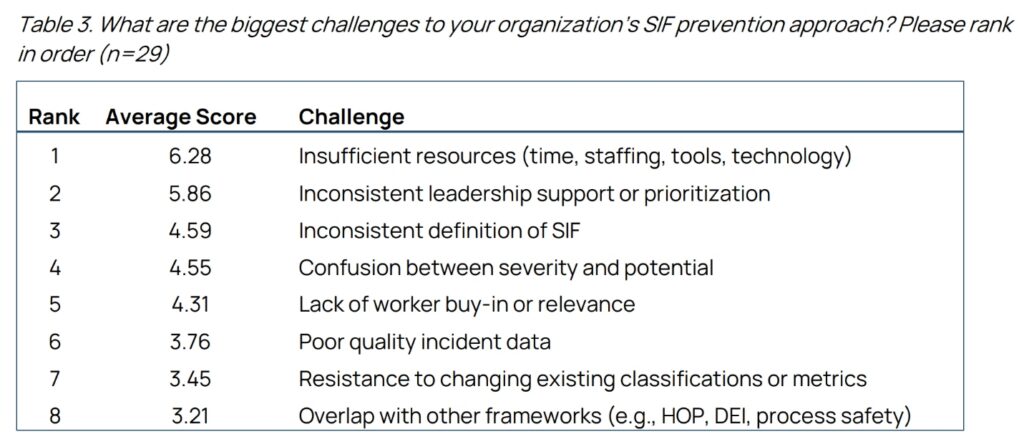
Ask EHS leaders what’s standing in the way of SIF prevention and you’ll hear about lack of resources and inconsistent leadership support or prioritization.
Insufficient resources ranked as the top obstacle in the research. SIF work requires time, staff, tools, technology and dedicated capacity. In many organizations, EHS teams are already stretched thin.
Inconsistent leadership support came in a close second. When executives treat SIF prevention as a non-negotiable, the work gains momentum. Here are some of the ways they can make their intentions clear:
Other challenges to SIF prevention included inconsistent SIF definitions, confusion between severity and potential and lack of worker buy-in.
One of the subtler challenges in SIF work is distinguishing between what did happen and what could have happened. A first-aid case might seem minor on paper, but if the same circumstances could have easily resulted in a fatality, that’s a signal worth acting on.
This is where the concept of potential SIFs (PSIFs) comes in. Several organizations in the study reported shifting their focus from SIF-only to PSIF, expanding attention to precursor events and early warning signs. One organization noted that 20% of their near misses involve SIF precursors. That single data point fundamentally changes how they prioritize learning and intervention.
The challenge is that traditional metrics don’t reward this kind of thinking. TRIR and other lagging indicators count injuries that happened, not the catastrophic injuries that were narrowly avoided. So teams end up managing two parallel realities: the official metrics that get reported up, and the real risk exposure that drives frontline decisions.
There’s no universal SIF solution waiting to be discovered. The work is too context-dependent and the risks are too varied. What works in oil and gas won’t translate directly to construction. What makes sense for a manufacturing plant may not apply to logistics. But there are principles that hold across industries.
It doesn’t have to be perfect, but it needs to be consistent enough that teams can align on priorities and compare data meaningfully. Organizations that have made progress stopped debating semantics and agreed on a workable definition anchored in life-altering harm.
Near misses, high-potential events and moments when something almost went catastrophically wrong offer crucial learning opportunities.
More than half of organizations report SIF-potential incidents to leadership. Nearly as many use dashboards or exposure analytics. Narrative briefings and storytelling ranked as a key communication method for 30% of respondents. When executives see the risk, they can resource the response.
Mature programs don’t just document that a control is in place. They test whether it works under real-world conditions. One standout example: an award-winning critical control assurance program requiring evidence from managers and frontline confirmation of effectiveness.
In multiple organizations, increased senior leadership understanding of SIF concepts transformed how safety is led and communicated. SIF prevention shifted from a technical problem to a strategic priority.
Think about SIF prevention as a fundamental shift in how your organization thinks about risk, learn from events and allocate resources accordingly. It’s not a one-and-done project.
Find more strategies to reduce serious injuries and fatalities here.
SIF prevention has become an important part of EHS strategy. Engagement is broad, emerging practices are taking hold and many leaders understand that preventing life-altering harm is the work that matters most.
Maturity levels vary. Some organizations are still defining terms while others are scaling enterprise-wide systems with standardized processes and proven controls. Most fall somewhere in between.
The opportunity now is moving from isolated SIF efforts to integrated systems. SIF prevention is hard work, as it should be. The stakes are too high for easy answers.
Want to learn more?
For more information on how to advance your organization’s SIF prevention strategy, download our free eBook.

Share
Complete the Following Information To Request Your Resource