EHS Research & Trends
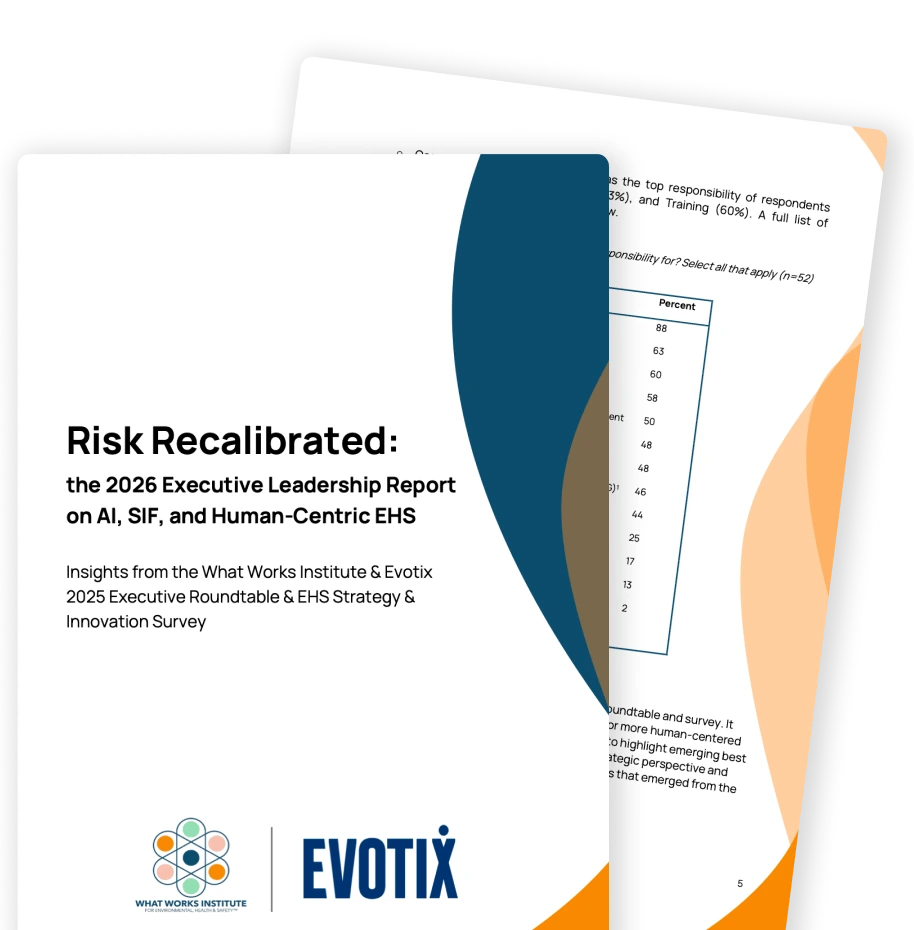
Risk Recalibrated: the 2026 Executive Leadership Report on AI, SIF and Human-Centric EHS
Research and insights from senior EHS professionals across manufacturing, utilities, construction and beyond.

How EHS defines and manages serious risk is overdue for a reset
2026 Research Highlights
5 Findings Shaping EHS Strategy
Organizations agree that preventing life-altering harm is the mission. But in practice, SIF prevention means different things depending on who you ask. 80% of organizations have started the work, yet definitions, scope and maturity vary widely across and within companies. Without a shared understanding of what qualifies as serious risk, teams are left interpreting it on their own — making it harder to classify incidents consistently, trust the data or align on where the most serious exposures actually exist.
Leaders agree on the destination — preventing life-altering harm — but not yet on the common language or tools needed to get there. This misalignment slows progress at a time when safety leaders won’t be satisfied with incremental change.
SIF maturity varies widely across organizations. 28% treat SIF as a core EHS component, while 20% have not started or remain unaware. The gap between leaders and laggards is significant.
Common practices are emerging, but not yet standardized . 68% incorporate SIF-potential criteria into incident investigations. Nearly 60% define SIF precursors. Only 16% use formal energy-based frameworks like HECA.
Resources are the #1 obstacle. Insufficient staffing, time and tools ranked first in challenges, followed by inconsistent leadership support.
The definition of “serious harm” is expanding. Some organizations now include occupational disease and acute mental-health crises as serious incidents, signaling a broader, more human-centered view of risk.
EHS leaders are asking themselves a rather uncomfortable question: Are we measuring the factors that actually prevent life-altering harm? And they’re not so sure. 1 in 5 EHS leaders report little to no connection between metrics and real risk, while 63% say there’s only partial alignment with notable gaps. Traditional lagging indicators like TRIR still dominate dashboards despite their well-known limitations. They obscure exposure to serious events and can distort data when tied to bonuses or ESG targets. Leaders recognize the need to shift toward measuring risk, exposure and prevention, but actual change has been slow.
“When you’re managing the optics of injury rates rather than the reality of serious-risk control, you’re not preventing serious harm, you’re just participating in performance theater.”
Most metrics don’t reflect real risk. Only 19% of EHS leaders believe their metrics closely track risk drivers. Nearly 20% report little or no connection between current safety metrics and true risk exposure.
Inertia keeps broken systems in place. External pressure from regulators, industry bodies, investors and legacy incentives reinforces traditional metrics, even when leaders know they fall short.
Redesign efforts are shifting upstream. 59% identified training and onboarding as the top area for overhaul, followed by investigations and learning systems (47%).
SIF exposure tracking is the next frontier. Ranked as the #1 priority focus over the next 18–24 months.
EHS has undergone rapid digitalization over the last few years. 94% of organizations now use some form of digital EHS management system, which provides a strong foundation for more advanced tools. AI is the next logical step, but most teams are still figuring out where it fits in their EHS program. Adoption is still early, with organizations exploring use cases that include practical, workflow-adjacent tasks like automated dashboards, predictive analytics and AI copilots. The interest is real, but so is the caution. Leaders are balancing the potential to surface patterns and insights with concerns about data quality, reliability and governance.
AI adoption is still in pilot mode. 42% are testing AI in limited scopes. 33% are exploring use cases. Only 8% are scaling strategically, while 17% have not started.
Use cases are practical and workflow-driven. Automated dashboards and copilots lead adoption. Computer vision, predictive analytics, and NLP for mining incident data are gaining traction.
Workforce trust is cautious, not resistant. 75% describe employees as curious but cautious. Transparency about what a tool will and won’t do matters enormously.
Governance will determine what scales. 58% cite accuracy, reliability, and bias as top concerns. Early involvement from IT, Legal, and Operations is essential.
Whether you’re deploying a new technology platform, redesigning metrics or building a more mature SIF program, culture determines whether it works. No new tool or program succeeds without trust on the frontline and visible executive buy-in. Misaligned incentives, like bonuses tied only to low incident rates,can discourage reporting and limit learning. Progress depends on integration. Many organizations still operate in silos. Only 27% of EHS teams collaborate regularly with HR, DEI or wellbeing, even as factors like fatigue, stress and mental health increasingly shape real-world risk.
EHS and HR are still largely siloed. Only 27% of EHS teams collaborate strategically and routinely with HR or wellbeing. 52% collaborate only occasionally.
Incentives can work against the goal. When bonuses are tied only to low incident rates, reporting and learning can suffer. Some organizations are beginning to reward hazard identification instead.
The appetite for peer learning is strong. 56% “definitely” see value in benchmarking with peers. 38% say “maybe.”
Cross-functional models are gaining traction. Structures like a Serious Risk Council, where leaders review both safety performance and business decisions that shift risk, are emerging as a path to sustained improvement.
Human-centric safety is gaining traction, but not yet embedded.
Human-centric safety is gaining traction. Leaders increasingly recognize the role cognitive load, mental strain, neurodiversity and other psychological factors play in risk. But most systems have yet to integrate these variables in a meaningful way. Only 3% of organizations report fully embedding psychosocial considerations into their EHS management approach.
Awareness is high. Integration is not. 71% recognize control of work conditions as a psychosocial factor. 66% recognize mental health strain, yet 89% have not fully embedded these factors into their EHS programs.
Competing priorities slow progress. 44% cite this as the biggest obstacle. Lack of clear measurement methods (19%) and unclear ownership between HR, EHS and wellbeing (14%) follow close behind.
There is demand for a shared maturity model. 78% would consider using a shared maturity framework to move from reactive to embedded integration.
Proven frameworks already exist. Standards like ISO 45003, the UK’s HSE Management Standards, and models from Australia and Canada provide practical starting points.

Get the full Risk Recalibrated report
The 2026 Executive Leadership Report on AI, SIF and Human-Centric EHS from Evotix and the What Works Institute