EBOOK | 15 MINUTE READ
EHS&S Leader's Guide to Implementing AI
While interest in AI is high, most health and safety teams are still in the early stages of exploration. EHS professionals know AI has potential, but many are unsure where to start or how to implement it responsibly without creating new risks.
If you are being asked to modernize your EHS program, improve visibility into risk or demonstrate ROI while maintaining trust and accountability, this guide provides a clear place to begin.
This guide will show you how to:
- Evaluate your current data and systems
- Find use cases that will deliver the most value
- Choose the tool that fits your organization
- Train and support your team
Turn AI uncertainty into a clear path forward
Get the guide to implement AI with purpose.
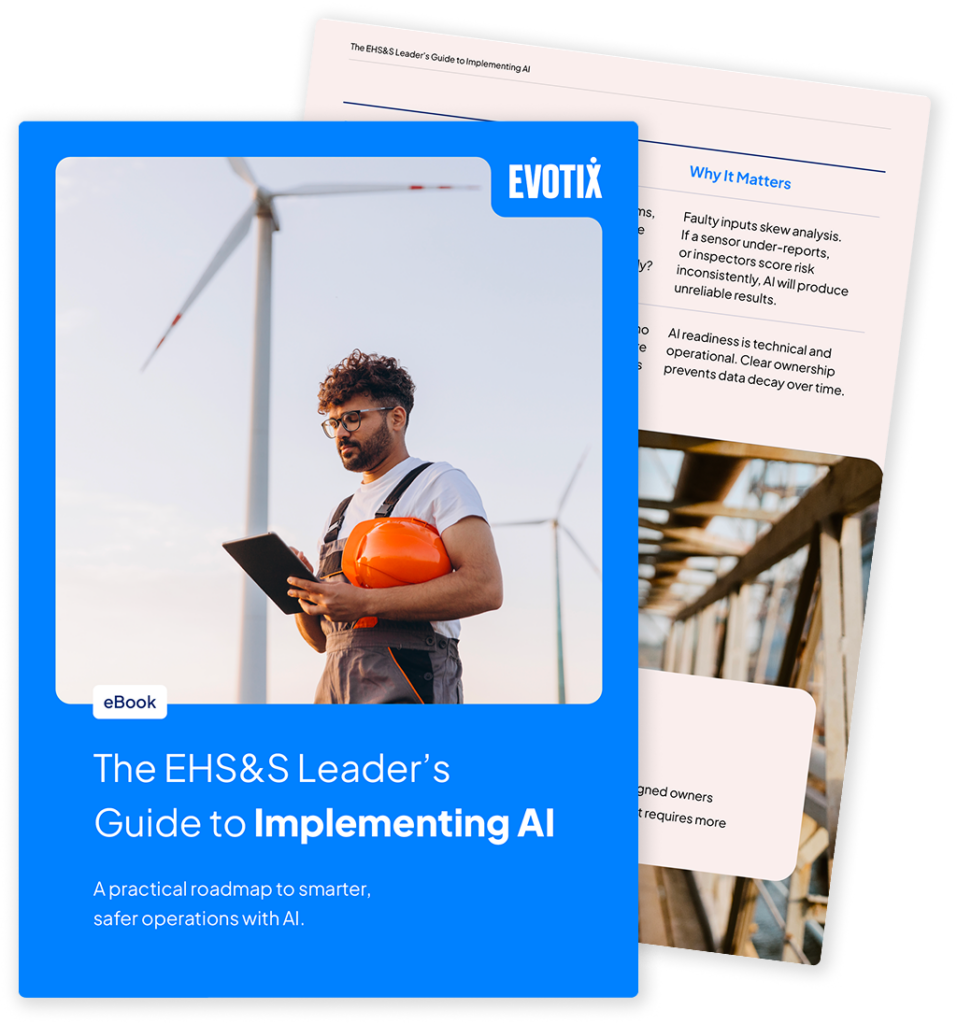
Why AI Matters for EHS Today
EHS leaders are under pressure to do more with less. They are expected to reduce incidents, support ESG reporting and demonstrate program value while managing disconnected systems and fragmented data.
AI offers a practical way to address these challenges. When implemented effectively, it helps organizations:
- Reduce manual effort tied to reporting and data entry
- Improve visibility into risk across operations
- Identify patterns and trends earlier
However, successful adoption depends on taking a structured, step-by-step approach rather than trying to apply AI everywhere at once. This guide details how to carefully approach implementing AI in your EHS processes.
The Four Steps to Implementing AI in EHS
This guide outlines a clear path for introducing AI into EHS workflows. Each step builds on the last, ensuring you create a strong foundation before scaling.
1.
- Start by understanding your current data and systems
Before implementing AI, organizations need a clear view of their existing data. Most EHS teams already have the information they need, but it is often scattered across spreadsheets, disconnected systems or inconsistent formats.
AI cannot fix poor data quality. It simply amplifies it. That is why the first step is auditing how data is captured, stored and structured across the organization. This process helps identify gaps, inconsistencies and opportunities for improvement.
A strong data foundation allows AI to recognize patterns accurately and produce insights that teams can trust.
2.
- Focus on the use cases that will deliver the most value
Once the data foundation is understood, the next step is identifying where AI can make a meaningful impact.
AI works best in areas where work is repetitive, data-heavy or time-sensitive. These are often the processes where teams spend the most time entering data, chasing information or trying to interpret trends.
Examples include incident reporting, inspections, risk identification and compliance tracking. Instead of trying to transform everything at once, organizations should prioritize a small number of high-value use cases that can be tested and measured.
Starting with a focused pilot helps build confidence and demonstrate value early.
3.
- Choose tools and partners that fit your organization
Selecting the right AI solution is not about finding the most advanced technology. It is about finding tools that integrate with your existing systems and support how your teams actually work.
The most effective solutions are built into existing EHS platforms rather than added as separate tools. This allows AI to operate within established workflows, improving adoption and reducing complexity.
Organizations should also consider factors such as data security, explainability and ease of use. AI in EHS must be reliable, auditable and aligned with regulatory requirements.
4.
- Train and support your team to build trust and adoption
Even with the right technology in place, success depends on people. Teams need to understand how AI works, what it does and how it supports their role.
Without clear communication, AI can feel like a “black box,” leading to resistance and low adoption. When positioned correctly, however, it becomes a helpful assistant that enables employees to work more efficiently and safely.
Training should focus on practical use, transparency and ongoing feedback. Organizations should also reinforce that human oversight remains essential, with AI supporting decisions rather than replacing them.
A Smarter Approach to EHS Performance
Implementing AI in EHS is not a one-time project. It is a structured process that starts with data, builds through practical use cases and succeeds through adoption. AI becomes most valuable when it is embedded into everyday workflows, providing insights and guidance in real time rather than as a separate tool.
When done well, AI enables organizations to:
- Improve data quality and consistency
- Identify emerging risks earlier
- Reduce time spent on administrative tasks
- Support more proactive, data-driven decisions
Who This Guide Is For
This resource is designed for EHS and sustainability leaders who want to:
- Modernize their safety programs without overwhelming their teams
- Reduce manual effort and improve data quality
- Use AI responsibly in regulated, high-risk environments
- Build internal alignment and confidence before scaling new technology
Whether you are just starting to explore AI or looking to move beyond experimentation, this guide provides a practical roadmap to help you move forward.
Make AI work for your team.
Download this guide to apply AI where it delivers real impact in your health and safety system.
FAQ
How is AI used in health and safety?
AI is used to automate reporting, identify patterns in incident data, detect hazards and support decision-making. It can analyze large volumes of EHS data to highlight risks, improve compliance tracking and suggest corrective actions.
What are the benefits of AI in EHS?
AI helps organizations improve efficiency, reduce manual work and gain better visibility into safety performance. It also supports proactive risk management by identifying trends and potential issues earlier than manual processes.
Is AI replacing EHS professionals?
No. AI is designed to support EHS professionals, not replace them. It handles repetitive tasks and data analysis, allowing teams to focus on higher-value activities such as risk management, training and continuous improvement.
What data is needed to implement AI in EHS?
AI requires consistent, structured and high-quality data. This includes incident reports, inspection results, audit data and other operational metrics. Without reliable data, AI outputs may not be accurate or useful.
What are the biggest challenges with AI in safety programs?
Common challenges include poor data quality, lack of integration across systems and low trust or adoption among employees. Many organizations also struggle to identify where AI will deliver the most value.
How do you get started with AI in EHS?
The best way to start is by auditing your data, identifying a few high-value use cases and running a focused pilot. From there, organizations can scale gradually as they build confidence and demonstrate results.