


See how teams reduce incidents and manage risk faster     See It in Action  →

What is Control of Work in Health and Safety?

Summary: Control of Work is a structured, connected approach to planning, authorizing, carrying out and closing work of varying risk levels. Control of Work allows organizations to gain the visibility, coordination and consistency necessary for safe and efficient work. 

What Is Control of Work?

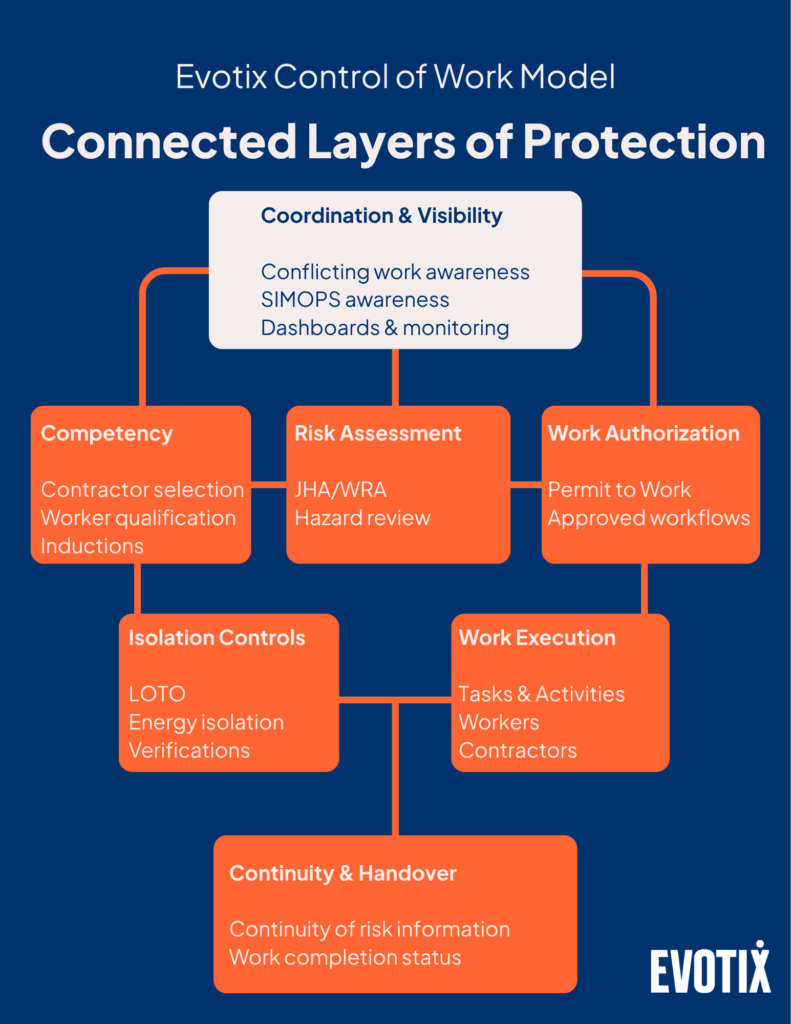
Control of Work ensures safety is integrated and considered across all aspects of a job task in a purposeful, connected manner. This process depends on multiple layers of protection working together to identify hazards, verify controls, coordinate work activities and manage changing risk. 

The steps involved in Control of Work start well before work begins and continue until the task is complete, the work area is returned to a safe condition or permits are closed. This process also accounts for changing conditions, simultaneous work and any outstanding risks that must be communicated between shifts. 

Common Control of Work Challenges

Many organizations already have risk assessments, permits, isolation procedures and approval processes in place. However, incidents can still occur when these activities operate independently rather than as a connected process. 

Common challenges regarding proper Control of Work include: 

  • Disconnected systems and paperwork: Critical information may be spread across multiple forms, spreadsheets or applications, making it difficult to maintain visibility
  • Limited visibility into active work: Supervisors may struggle to understand what work is taking place, where it is occurring and whether conflicts exist
  • Communication gaps: Important information about hazards, isolations or outstanding work can be missed during shift changes or contractor handovers
  • Managing simultaneous operations (SIMOPS): Multiple activities occurring in the same area can introduce additional risks that are difficult to identify without proper coordination

What Does Effective Control of Work Look Like?

Control of Work is best viewed as layers of protections that, when properly connected and managed, ensure the right controls are in place for safe work to be carried out. There is no one-size-fits-all approach to managing risk, so Control of Works helps match the level of controls needed to the level of risk of a job task. 

While the specifics vary by industry and operation, an effective Control of Work program includes the following aspects: 

  • Integrated Safety Plan: This is the central coordinating mechanism that brings together all work elements. Not every work task requires all aspects of Control of Work, so an Integrated Safety Plan ensures the work is supported at the right level of risk.  
  • Job Hazard Analysis: This assessment identifies job related hazards and determines appropriate controls. 
  • Lockout/Tagout: Lockout/Tagout (LOTO) procedures are triggered by work permits. When LOTO is triggered, PTW cannot commence or be removed until LOTO is confirmed. 
  • Permit to Work: Work permits are triggered by the requested task. Only identified workers with current introduction are permitted to complete the task or be on site while work is carried out. 
  • Shift Handover: Important information must be transferred between shifts and captured when work is completed to properly communicate open permits and outstanding work, transfer isolation and risk information between shifts and verify work completion. 
  • Workplace Risk Assessment: Work requests cannot be approved until risk assessments or Job Hazard Analysis (JHA) are reviewed and accepted. 

For most organizations, the processes above are not designed to work in conjunction with one another. For this reason, an effective Control of Work system offers a way to efficiently connect all necessary assessments, approvals, procedures and management aspects to ensure safe work. 

To better explain how an effective Control of Work program for EHS should be structured, picture the layers in the following way: 
Benefits of Control of Work

Implementing Control of Work processes into workplace operations provides various benefits to an organization. By connecting simultaneous and complex work processes, safety teams are better able to: 

  • Improve operational efficiency: Connecting work dependencies allows organizations to carry out work more efficiently and establish safe working conditions in a streamlined manner. It also helps reduce delays caused by manual paperwork, disconnected systems and inconsistent approval processes. 
  • Standardize safe work practices: Consistent permit templates and help establish a common approach to managing hazardous work across locations, departments and contractors. 
  • Reduce incident and downtime costs: Fewer incidents, better planning and improved visibility into active work can help reduce costly disruptions, equipment damage and unplanned shutdowns. 

The implementation of digital Control of Work tools helps amplify the benefits above. See why the future of Control of Work lays in digitial solutions below. 

Table of Contents

About the author

Elizabeth Schlaker

Elizabeth is an EHS Content Specialist at Evotix who focuses on translating complex safety, risk and compliance topics into digestible, informational content. She writes on a wide range of subjects, including risk management, incident management, serious injury and fatality (SIF) prevention and audits and inspections.

Share