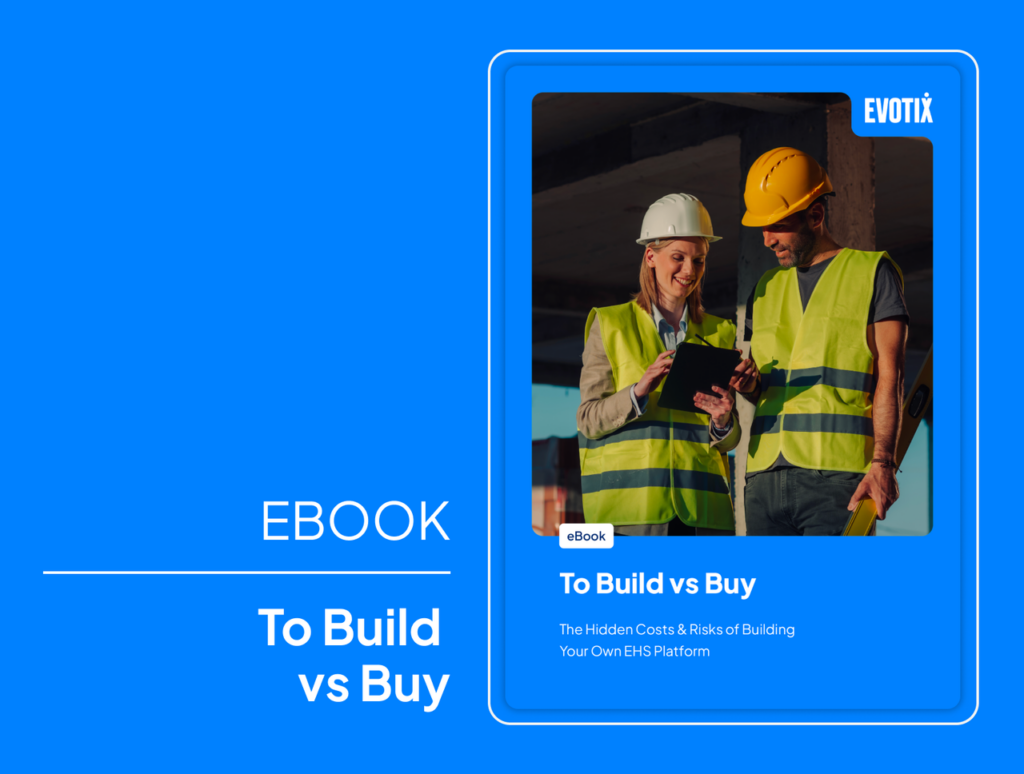
EBOOK | 15 MINUTE READ
To Build vs Buy: The Hidden Costs & Risks of Building Your Own EHS Platform
When looking to automate their health and safety processes, many organizations face the same dilemma: work with their internal IT team to build their own in-house solution or partner with a vendor that has specialized experience in EHS software?
In this eBook you’ll evaluate:
- Whether you have enought internal resources to maintain an internal EHS platform
- Where AI can (and should) add value
- What long-term ownership truly means
Should you build your own EHS platform?
Get the insights you need to evaluate this decision with confidence.
Why More Organizations Are Considering an Internal Build
There are valid reasons why organizations explore building an EHS platform internally. AI has certainly lowered the barrier to entry, allowing teams to create working models, automate workflows and connect datasets with relative ease. This can be especially appealing for organizations with unique safety processes or specific operational requirements.
In early stages, internal solutions can appear to provide flexibility and speed. They allow teams to experiment, iterate and tailor functionality closely to how work is done on the ground. Over time, however, the decision to own an internal EHS platform becomes more nuanced.
Understanding the Full Scope of Owning an EHS Platform
One of the most important aspects of deciding whether to own an internal EHS&S software or partner with an external software provider is understanding what ownership looks like over time.
Initial development is only one part of the equation. Health and safety systems must be maintained, adapted and supported as the organization evolves. This includes responding to new requirements, integrating with other systems and ensuring that data remains consistent and reliable.
In practice, this often involves:
- Maintaining workflows as processes change
- Managing integrations with other business systems
- Updating controls in response to regulatory and operational shifts
- Supporting users across sites and teams
For some organizations, this level of ownership aligns with existing capabilities. For others, it introduces new responsibilities that extend beyond the original scope of the project.
Get a clearer view of what you’re taking on.
Uncover the long-term implications of building vs buying your EHS platform.
The Role of Data, Security and Compliance
EHS systems have become more central to organizations overtime, now managing a wide range of information including operational data, worker records and detailed incident information. This data is increasingly subject to regulatory and privacy expectations, which vary by region and continue to evolve.
As a result, decisions around EHS platforms often involve considerations beyond mere functionality, including:
- How data is managed, stored and accessed
- How records are retained and audited over time
- How systems adapt to changing regulatory expectations
These considerations apply regardless of whether a system is built or purchased. What differs is how responsibility for managing the EHS platform is structured within the organization.
Where AI Fits Into EHS
AI has introduced new opportunities, but also new considerations. AI can accelerate development, support analysis and enhance workflows. At the same time, it depends heavily on the quality, structure and governance of underlying data.
In many cases, AI adds the most value when it builds on an existing foundation, where data is already structured and processes are well defined. The key question is not whether to use AI, but where it fits within the broader system and how it supports long-term goals.
Questions To Consider Before Deciding
Before moving forward with a build or buy approach to your platform, it can be helpful to step back and assess how the system will function over time.
A few questions can help frame the decision:
- How will the system evolve as new requirements and workflows are introduced?
- What level of consistency is required across sites and teams?
- How will data be governed, secured and retained over the long term?
- Who will own the system as it grows and changes?
- How will new technologies, including AI, be integrated and managed?
These questions do not point to a single answer. Instead, they help surface the factors that shape successful long-term outcomes.
Want to learn more?
Explore the key risks, costs and considerations of maintaining your own EHS platform.
FAQ
Is it realistic to build an EHS software platform using AI?
Yes, it is increasingly realistic to build functional EHS tools using AI and modern development platforms. Many organizations can now prototype workflows, automate forms and connect systems much faster than before.
The key consideration, however, is not whether it can be built, but whether the organization can sustain it over time as requirements evolve and systems become more complex.
What are the advantages of building an EHS system internally?
Building internally can offer flexibility, especially for organizations with unique workflows or highly specific operational requirements. It can also allow teams to iterate quickly and tailor processes closely to how work is actually performed.
In early stages, this can make internal builds appealing, particularly when speed and customization are priorities.
What are the biggest risks of building an EHS platform in-house?
The risks tend to emerge over time rather than at the beginning.
Common challenges include:
- Maintaining consistency across workflows as the organization grows
- Managing data governance and access control for sensitive information
- Ensuring records remain accurate and defensible years after they are created
- Supporting the system as regulations, sites and operational needs change
These are ongoing ownership challenges rather than initial build challenges.
How much does it actually cost to build vs buy EHS software?
Most of the cost of any enterprise system typically sits in long-term maintenance, updates, integrations and support. These costs are less visible at the start but tend to grow over time as the system expands and requirements change.
Can internal teams realistically manage EHS data security and compliance?
It depends on the organization’s capabilities and resources.
EHS systems now manage sensitive data, including personal, medical and operational information. Managing this data requires strong governance, consistent access controls, compliance with evolving regulations and the ability to respond to security risks.
Some organizations are equipped to manage this internally. Others find that it introduces new responsibilities that extend beyond traditional EHS functions.
When does it make more sense to build internally?
Building internally may make sense when:
- The organization has strong internal engineering, security and governance capabilities
- Requirements are highly specialized and not well supported by existing platforms
- There is a clear long-term plan for ownership and maintenance
The decision should be based not only on current needs, but on the organization’s ability to sustain the system over time.
When does it make more sense to buy an external EHS platform?
Buying an external platform may be more appropriate when:
- Standardization and consistency across sites are a priority
- There is a need for structured governance, compliance and auditability
- Internal resources are limited or focused elsewhere
In these cases, organizations may choose to focus on outcomes while relying on an external partner to manage underlying infrastructure and updates.
Can organizations combine both approaches?
Yes, and many do. A common approach is to use a core EHS platform as the system of record while building lightweight tools, integrations or AI-driven workflows around it. This allows organizations to retain flexibility while maintaining a stable, governed foundation.