Workplaces must be managed holistically, both to keep workers safe and ensure the continued resilience of the business.
This is where the bowtie analysis can help. It gives a broader perspective, allowing you oversight across the entirety of the business. This lets you prioritize actions with the full knowledge that you have a comprehensive grasp of the situation.
What Is the Risk Management Bowtie?
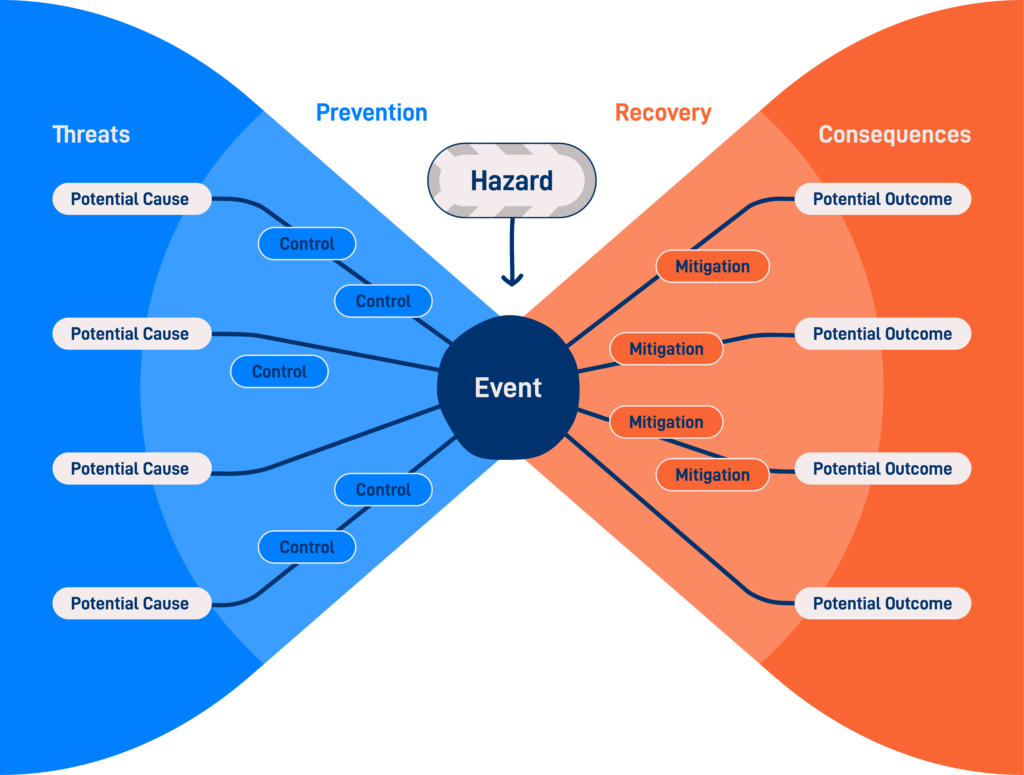
The risk management bowtie is a visual diagram that maps the threats, mitigative controls, consequences and preventative barriers for any given workplace hazard:
- Hazard and top event: In the center lies the hazard, something with the potential to cause harm, and the top event, the moment the hazard leads to an event.
- Threats: The left side of the bowtie lists the threats, or the specific things that could lead to the top event happening.
- Preventative barrier: Next to each threat, you place a preventive barrier. These are controls designed to stop that threat from ever triggering the top event. There can be multiple preventive barriers for a single threat. This is where you should also identify which mitigation controls are critical, meaning they must be in place to prevent life threatening harm.
- Consequences: On the far-right side lie the consequences. This is what happens if the top event gets triggered.
- Mitigative barrier: To the left of the consequences is the mitigative barrier, which is something that reduces the damage once the event has already happened. There can be multiple mitigative barriers added to a single consequence.
When all the elements are added, the diagram resembles a bowtie, hence the name.
Example of the bowtie methodolgy
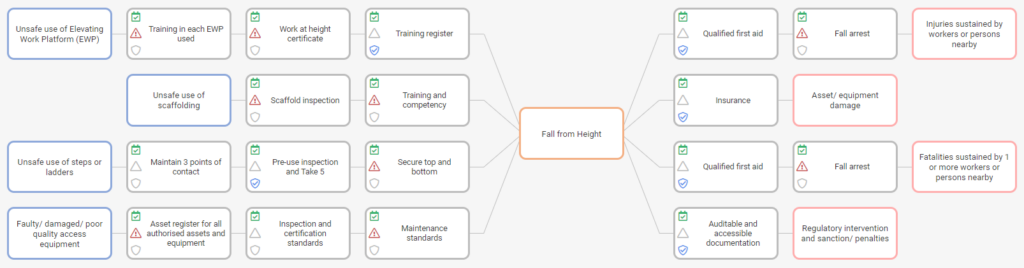
To better understand this, let’s use an example of a fall from height. Using the risk bowtie for this scenario, the hazard would be working from a height, and the top event would be falling.
Threats to falling from height could include unsafe use of elevated work platforms, unsafe use of ladder, or faulty equipment. The preventative barriers for these threats could be a work at heights certificate, pre-use inspection, and an asset register for all equipment.
On the right hand side, the consequences of a fall from height could be injury, downtime, and compensation costs. To reduce damages, add harnesses, a trained emergency response team and insurance as your preventative barriers.
Benefits of Incorporating the Bowtie Diagram Into Risk Management Strategy
One of the biggest advantages of a bowtie is that it breaks down complex hazards into manageable controls. Instead of looking at controls separately, you can see all the different ways an incident could occur, what barriers are in place to prevent it and what protections exist if something still goes wrong.
Most importantly, using the risk management bowtie can help visualize which controls are deemed “critical” for preventing the hazard from leading to a serious injury or fatality. Once a control is considered critical, safety leaders know that that control must be verified, maintained and working at all times.
Other benefits include:
- Identify unintended consequences where controls potentially conflict with each other
- Offer objective perspectives to help with prioritizing actions and preventing blind spots
- Engage workers in risk management discussions and help demonstrate the full reality of implementing controls
Connection to Other Risk Management Tools
The bowtie analysis should be used alongside other risk management tools. Where a risk assessment and risk matrix helps you rank how severe a risk is, the bowtie method shows you why it’s severe and which controls are necessary.
From there, it’s important to have a streamlined way to implement and check the verification of controls.
Want to see how the bowtie methodology connects to other risk management tools?
Learn how to manage open items found through risk assessments.