


There’s a version of workplace safety that looks good on paper. The team completes checklists, training and reporting as usual. Metrics and incident rates look good. Yet, there are gaps that cause something to go wrong:
Human-centric safety attempts to close these gaps by building safety systems that account for how people actually think, feel and function.
New research from Evotix and What Works Institute suggests widespread recognition among EHS leaders that human factors belong in safety programs. Turning that recognition into embedded practice is where most organizations are falling short.
Human-centric safety is an approach to EHS management that treats human performance as a factor to design around rather than a matter of individual discipline. The goal of human-centric safety is to design conditions where people can reliably make safe decisions, even when they’re tired, distracted or under pressure.
In practice, that means accounting for factors like:
Most safety programs are still built on the assumption that incidents happen because someone made a bad choice. Train people well enough, hold them accountable and performance will follow. But the same task carries substantially different risk depending on the person doing it and the unique conditions that influence them.
Human-centric safety accounts for that reality by changing the core question. Instead of asking whether a worker followed the procedure, it asks what conditions shaped that decision. That reframe affects how organizations investigate incidents, where they look for leading indicators and how they hold people accountable. A hazard assessment built only around the physical environment captures part of the picture; human-centric safety is the rest of it.
The uncomfortable truth is that most EHS leaders already know psychological factors drive serious risk, but few are actually doing anything about it.
When survey respondents were asked which psychosocial contributors to serious harm they recognize in their organizations, 71% acknowledged control of work conditions, 66% cited mental health strain like stress, burnout or anxiety and 60% flagged fatigue or cognitive overload.
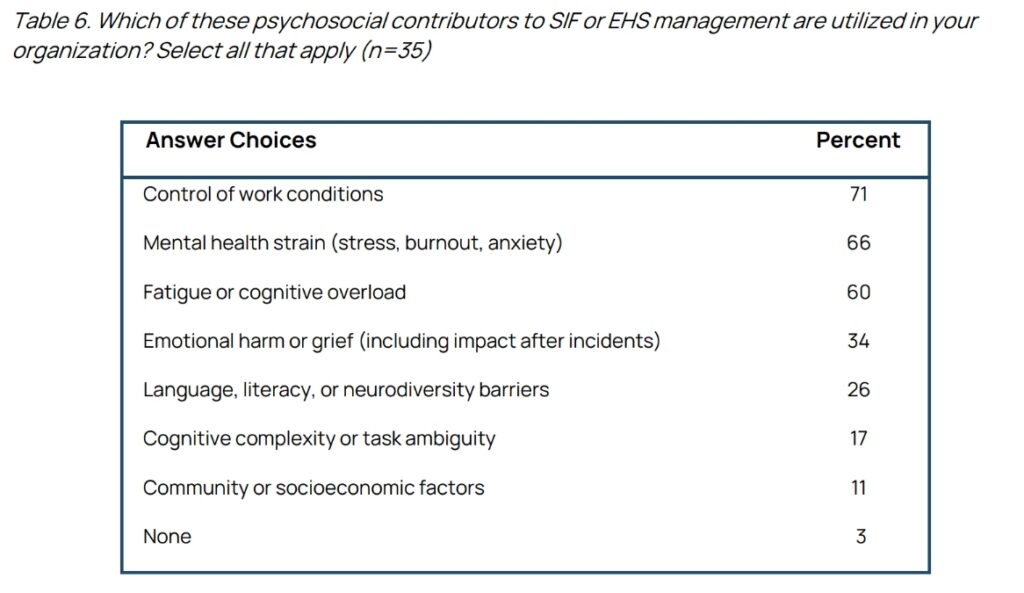
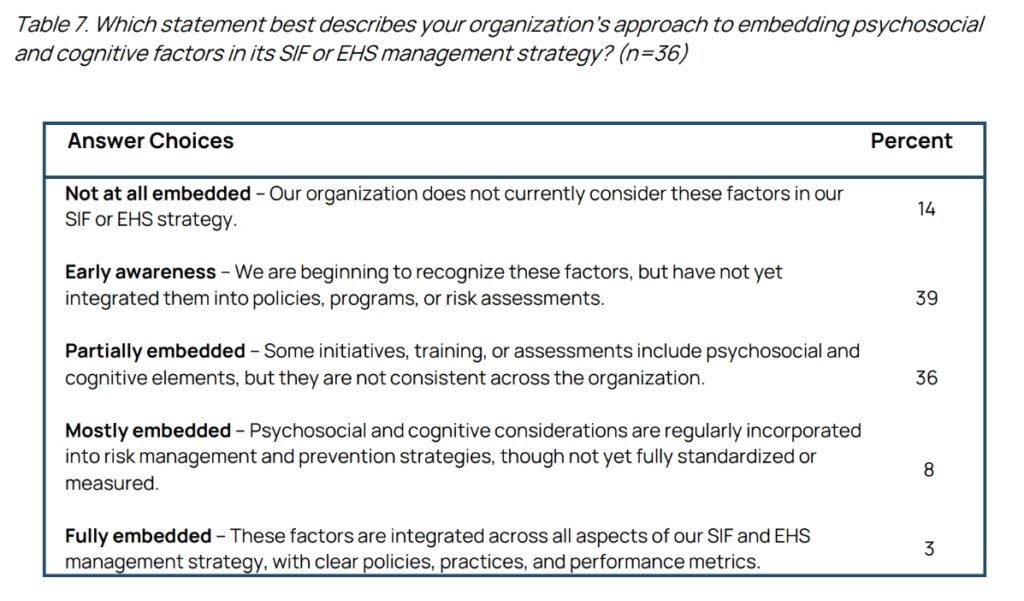
However, when asked how well those factors are actually embedded in their EHS programs, the picture shifted dramatically. Only 3% said psychosocial and cognitive factors are fully integrated into their management systems. Just 8% said mostly integrated. The remaining 89% said these factors were either not embedded at all or only partially present across the organization.
When asked about the single biggest barrier to integrating psychosocial and cognitive factors into their organization’s EHS management system, 44% of leaders pointed to competing organizational priorities.
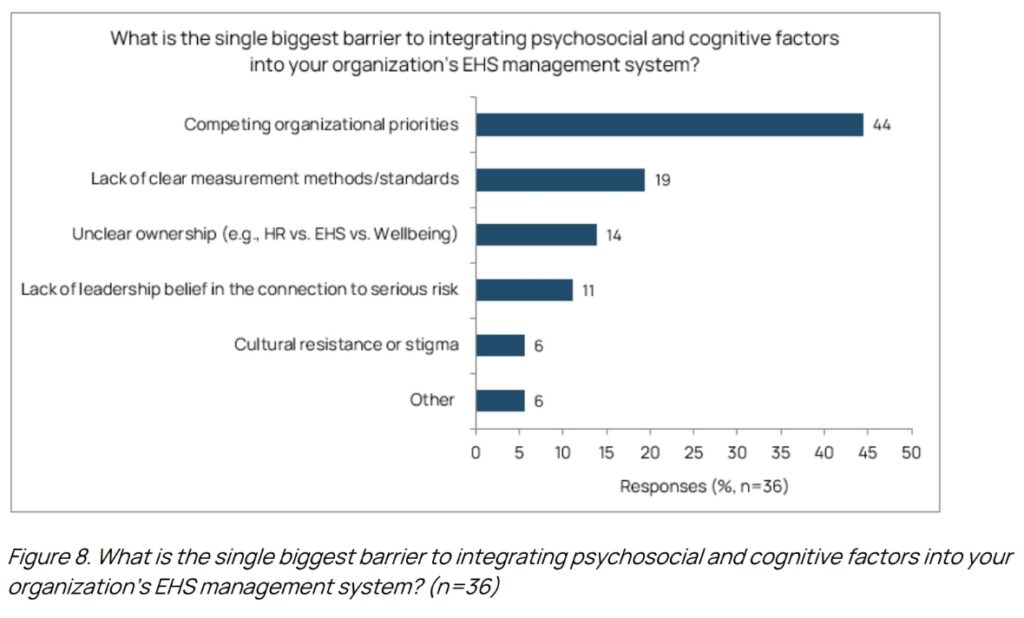
19% cited lack of clear measurement methods or standards. EHS programs run on metrics, and psychosocial risk resists easy quantification. It’s genuinely hard to build a dashboard for cognitive load or put a consistent number on psychological safety in a way that holds up in a leadership review.
14% pointed to unclear ownership. Psychosocial risk sits at the boundary between EHS, HR and wellbeing functions, and in many organizations that boundary is where accountability goes to die. Nobody has formally claimed it, so nobody fully manages it.
For a deeper look at what psychosocial hazards are and how organizations go about identifying them, see our overview of psychosocial risks in workplace safety. Human-centric safety connects those conditions directly to operational risk, rather than treating them as a separate initiative.
Of all the factors that predict progress on human-centric safety, the way executives talk about it matters most. When senior leaders treat fatigue, mental health and inclusion as operational safety concerns, programs get traction.
Visible executive sponsorship changes behavior downstream. When leadership opens quarterly reviews with serious-risk discussions and holds middle managers accountable for surfacing precursor data, the culture shifts. The same dynamic applies to human factors. If a CEO talks openly about fatigue risk the same way they talk about fall protection, that signal travels.
If you’re an EHS leader who wants to build a more human-centric safety program, here are some practical things you can start implementing today.
Add a human factors prompt to your existing investigation template. Train investigators to pause before drawing conclusions and map the environment the worker was actually operating in. What did their day look like? What pressures were present? Adding this step can change what gets recorded and what gets acted on.
Most high-hazard operations already run some form of pre-job brief. Spend two minutes checking whether the team is in the right state of mind to execute the work safely that day. Doing this regularly builds a culture where human readiness gets assessed before an incident forces the conversation.
Pull overtime records alongside near-miss and high-potential incident data and map the relationship. That correlation, once visible, gives you concrete evidence to bring into scheduling conversations and operational planning decisions.
SIF prevention creates one of the most practical entry points for psychosocial risk. The work already demands asking what conditions made this event possible, so take advantage of that opening. Fatigue, workload and psychological safety fit naturally into that conversation without requiring a new initiative, budget line or buy-in.
Train observers to note psychosocial stressors during routine walkarounds alongside physical hazards: signs of fatigue, visible production pressure, rushed handovers or steps being skipped under time constraints. Logged consistently, those observations connect working conditions to risk exposure in ways incident records alone cannot.
Most organizations already have touchpoints (investigations, audits, pre-job briefs, performance reviews, etc.) where human factors can be folded in. You don’t have to start this work from scratch. Take a look at your existing systems and determine where you can make the process more human-centric.
One roundtable participant put it directly:
“Human-centricity isn’t a separate initiative. It is an organizing principle for how modern safety systems must evolve.”
78% of EHS leaders said they would use a shared maturity model for psychosocial risk integration if one existed. In general, there’s no common framework for assessing cognitive load in a pre-job brief. However, frameworks like Human and Organizational Performance (HOP) and NIOSH’s Total Worker Health have given the field a useful foundation for thinking about this.
Work is also happening internationally. The UK Health and Safety Executive’s management standards for work-related stress, ISO 45003 on psychological health and safety, and related frameworks from Australia and Canada all provide working models. Although, none have been widely adopted in North America.
Results depend on leadership commitment, a trust-based culture and deliberately integrated systems that make it easier for people to do the right thing under real-world pressures.
If you only take one thing away from this research, let it be this: stop treating the factors that actually drive harm as secondary concerns. Fatigue, burnout and psychological safety are real risk factors and should be treated as such. The programs that prevent life-altering harm will be the ones that treat those realities with the same level of integrity as physical hazard controls.
Advances in technology and deeper understanding of human factors present an opportunity to radically improve risk prevention, but only if leaders recalibrate their approaches.
Want to learn more?
Download the full 2026 Risk Recalibrated report for more insights.

Share