WHITEPAPER | 15 MINUTE READ

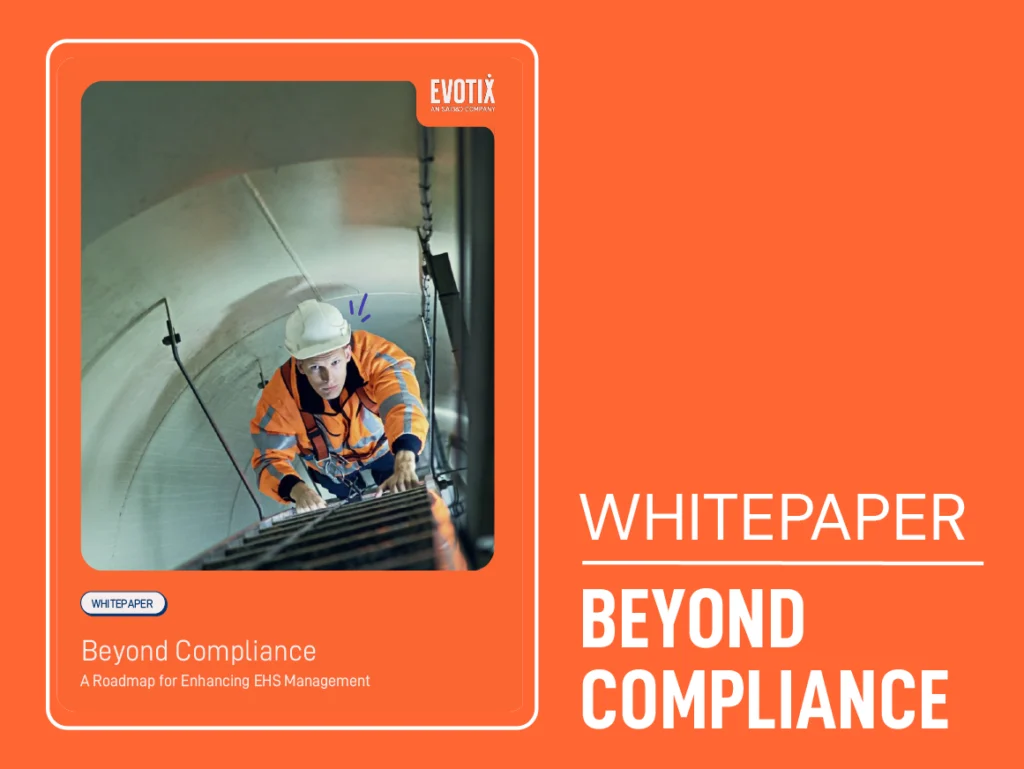
Enhancing EHS Management Beyond Compliance

Compliance is essential to health and safety, but it is only the starting point. 

Many organizations build their health and safety programs around meeting regulatory requirements. While this ensures a baseline level of protection, it rarely delivers the visibility, consistency or foresight needed to manage risk effectively at scale. 

A more mature approach:

Compliance is just the starting point

Get the roadmap to build a more proactive, risk-based EHS program.

The Limits of Compliance-Driven EHS Programs

Compliance-focused programs are designed to meet minimum standards. However, they are often reactive by nature, centered on following rules, passing audits and responding to incidents after they occur. This approach creates several risks over time. 

First, it can lead to a narrow view of safety. When the focus is on meeting requirements, organizations may overlook emerging or interconnected risks that fall outside of regulatory checklists. 

Second, compliance-driven processes often operate in silos. Departments and locations may follow the same rules, but apply them differently, resulting in inconsistent data and limited visibility across the organization.  

Finally, it can reinforce a reactive mindset. Teams focus on fixing problems after they occur rather than identifying patterns, anticipating issues and preventing incidents altogether. 
From Compliance to Risk-Based Thinking

A risk-based approach to health and safety expands the role of EHS from meeting basic requirements to actively managing workplace risk, hazards and incidents. 

Instead of asking, “Are we compliant?” organizations begin to ask: 

  • What risks exist across our operations? 
  • How do those risks interact and evolve over time? 
  • Where are we most vulnerable? 

This shift requires organizations to look at risk in aggregate, not just in isolated processes. It also requires stronger alignment between EHS, operations and broader business strategy.  

By focusing on emerging risk rather than compliance alone, organizations can identify blind spots earlier, allocate resources more effectively and reduce the likelihood of incidents before they occur. 

Using ISO 31000 as a Framework for EHS

Unlike certification standards, ISO 31000 is a set of guidelines that helps organizations design and embed effective risk management practices across the business. It applies not only to EHS risks, but also to operational, financial and strategic risks.  

At its core, ISO 31000 emphasizes three connected elements: 

  • Principles that guide how risk is managed 
  • Frameworks that define how risk management is embedded into the organization 
  • Processes that ensure risks are identified, assessed and treated consistently 

These elements are designed to work together. Treating them as separate activities often leads to gaps, while aligning them creates a more cohesive and scalable approach.  

What ISO 31000 Looks Like in Practice

Applying ISO 31000 shifts EHS management in several important ways. It encourages organizations to treat risk management as iterative and continuous, rather than a one-time exercise. Risks are monitoredreviewed and adjusted as conditions change.  

It also highlights the role of leadership and integration. Risk management is not confined to one department. It becomes part of how decisions are made across the organization.  

Finally, it emphasizes context and adaptability. Risk management processes should reflect the specific environment in which an organization operates, rather than relying on rigid, one-size-fits-all models.  

Managing Workplace Risk as a Connected System

To move beyond compliance, organizations need to understand how risks interact across systems, teams and processes. An integrated approach helps break down silos and create a more complete picture of risk. This makes it easier to identify unintended consequences, conflicting controls or gaps that may not be visible when risks are managed separately.  

Methods such as structured risk analysis and visualization techniques can support this by making it easier to see relationships between hazards, controls and outcomes. This approach improves not only awareness, but also decision-making. Organizations can prioritize actions based on real impact rather than isolated observations.  

Building Toward EHS Maturity

Moving beyond compliance should be a continuous effort. Organizations typically move through stages, starting with compliance, then building toward proactive risk management and eventually reaching a more integrated, optimized state. 

This progression requires: 

  • Consistent processes across teams and locations 
  • Strong engagement and communication 
  • Clear visibility into risks and performance 
  • A commitment to continuous improvement 

Want to learn more?

Get the roadmap to build a more proactive, risk-based EHS program.

Complete the Following Information To Request Your Resource