CHECKLIST | 5 MINUTE READ

AI Implementation Checklist for EHS&S Leaders

EHS professionals are under more pressure than ever. With tight resources and a growing regulatory demands, many health and safety teams are struggling to do more with less. AI tools offer an opportunity to take some of the administrative pressures off of the EHS professional to help them focus more time on high-impact safety practices.  

But adopting AI without a clear strategy can create new risks, wasted investments and confusion across your organization. Tools alone do not drive results. Intentional planning does.  

That is why we created the AI Implementation Checklist for EHS&S Leaders, so you can move forward from curiosity to action. 

AI Implementation Checklist Thumbnail

Why an Intentional AI Strategy Matters

An intentional approach to implementing AI helps you: 

  • Align AI initiatives with real EHS priorities 
  • Focus on use cases that deliver measurable safety and efficiency gains 
  • Prepare your data, systems and processes before scaling 
  • Build trust and confidence among frontline teams 
  • Establish guardrails for responsible, ethical AI use 

This checklist is full of essential prompts to help you ask the right questions before, during and after AI adoption. 

How Should You Implement AI Across EHS Practices?

Intentional AI implementation requires thorough auditing, planning and evaluation. Inside this checklist, you will be guided through six critical stages of AI adoption: 

  1. Assess AI readiness: Evaluate your current processes, data quality, technology landscape and organizational appetite for AI. Understand where you are starting so you can set realistic expectations. 
  2. Identify high-value use cases: Prioritize AI opportunities that align with your biggest EHS challenges, whether that is incident analysis, inspections, reporting or risk identification. 
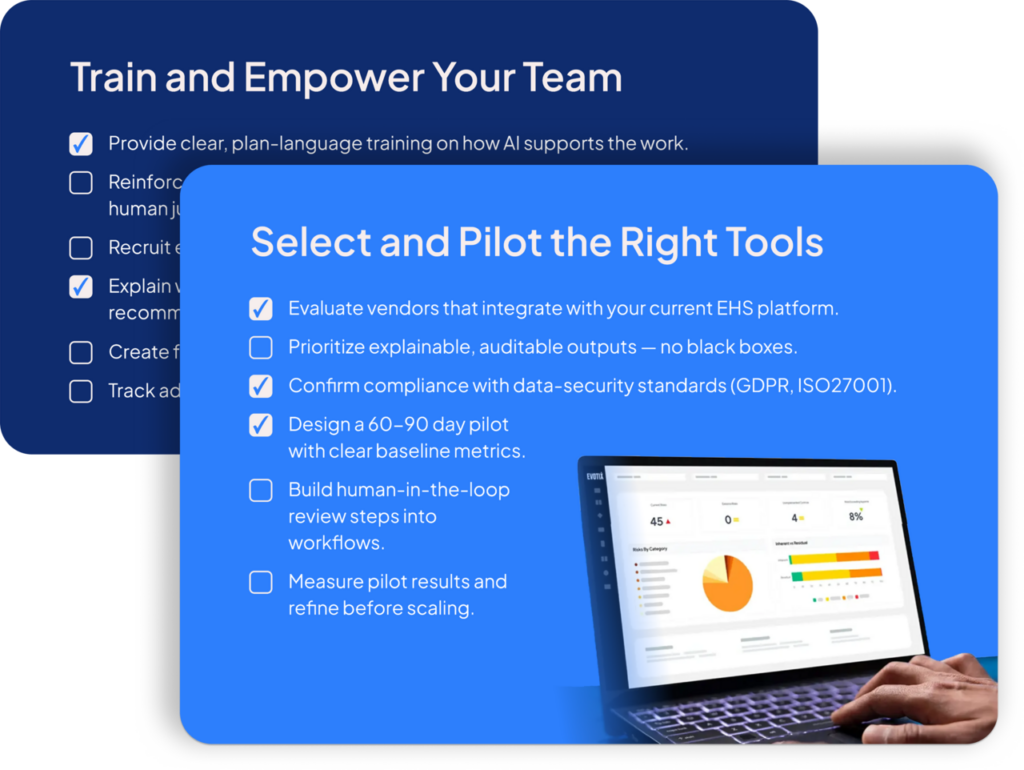
  3. Selecting and piloting the right tools: Learn how to evaluate AI solutions, run effective pilots and avoid common pitfalls that stall momentum. 
  4. Train and empower your team: Ensure your people understand how AI supports their work, not replaces it. Drive adoption through transparency and education. 
  5. Govern and grow responsibly: Put guardrails in place around data use, accuracy, accountability and ethics so AI remains a trusted part of your EHS ecosystem. 
  6. Measure, communicate and evolve: Track impact, share wins and continuously refine your approach as AI capabilities and business needs change. 

AI becomes powerful in EHS and ESG when the fundamentals are strong, your use cases are intentional and your people understand how it fits into their daily work. This checklist helps you slow down just enough to get it right.